Morganite

Morganite belongs to the beryl family and is therefore a direct relative of emerald and aquamarine. Its delicate pink to peach tint makes it one of the most attractive coloured gemstones. It was named after the American banker and gem collector J.P. Morgan.

On this page, you will find out which quality criteria a morganite must meet, which regions produce the most valuable stones and whether this gemstone is suitable as an investment.

Morganite
  • logo-allgemeine-zeitung
  • dawo-logo
  • finanzwelt-logo
  • wallstreet-logo
  • logosachwert-magazin-logo

What Makes a Morganite Valuable?

The value of a morganite is determined by the classic criteria of colour, clarity, cut and carat weight. As a beryl, it shares many properties with its more famous relatives.

Colour as the decisive criterion

The colour palette of morganite ranges from delicate pink through peach to strong pink. The most sought-after stones show a rich, intense pink without orange or brown secondary tones. The colour should be evenly distributed and still clearly visible even in smaller stones.

Like aquamarine, morganite shows pleochroism. Depending on the viewing angle, the stone appears in different shades of pink. An experienced cutter orients the crystal so that the table shows the most attractive colour.

Clarity

Morganite often occurs with good clarity. For an investment, the stone should be eye-clean, i.e. show no inclusions visible to the naked eye. Loupe-clean specimens of good size command premium prices.

Cut

The cut must show off the delicate colour of morganite to best effect. Popular cuts are oval, cushion and the classic step cut. A deeper cut can enhance the colour saturation of lighter stones.

Carat weight and price

Like many beryls, morganite occurs in large crystals. Stones of 10, 20 or more carats are not uncommon. This availability in large sizes keeps the price per carat moderate.

Investment quality with intense colour and high clarity currently costs around €600 to €950 per carat. In 2024, large stones of 20 carats or more in investment quality averaged around €950 per carat. For a serious investment, we recommend stones of 5 carats or more.

Gem

Morganite Treatments

Most morganites on the market have undergone heat treatment. It is important to understand this treatment, as it affects value.

Heating to improve colour

Rough morganite often shows an undesirable yellow or orange tinge. Heating to around 400 degrees Celsius removes these secondary tones and produces a purer pink. This treatment is permanent, accepted in the trade and does not always have to be disclosed.

Untreated morganites with a naturally pure pink are rare and fetch higher prices among collectors. However, proving this requires a gemmological examination, as the treatment leaves no detectable traces.

Irradiation

Occasionally, pale morganites are irradiated to intensify their colour. This treatment is less stable and should be disclosed. For investments, we recommend only non-irradiated stones.

Mining regions

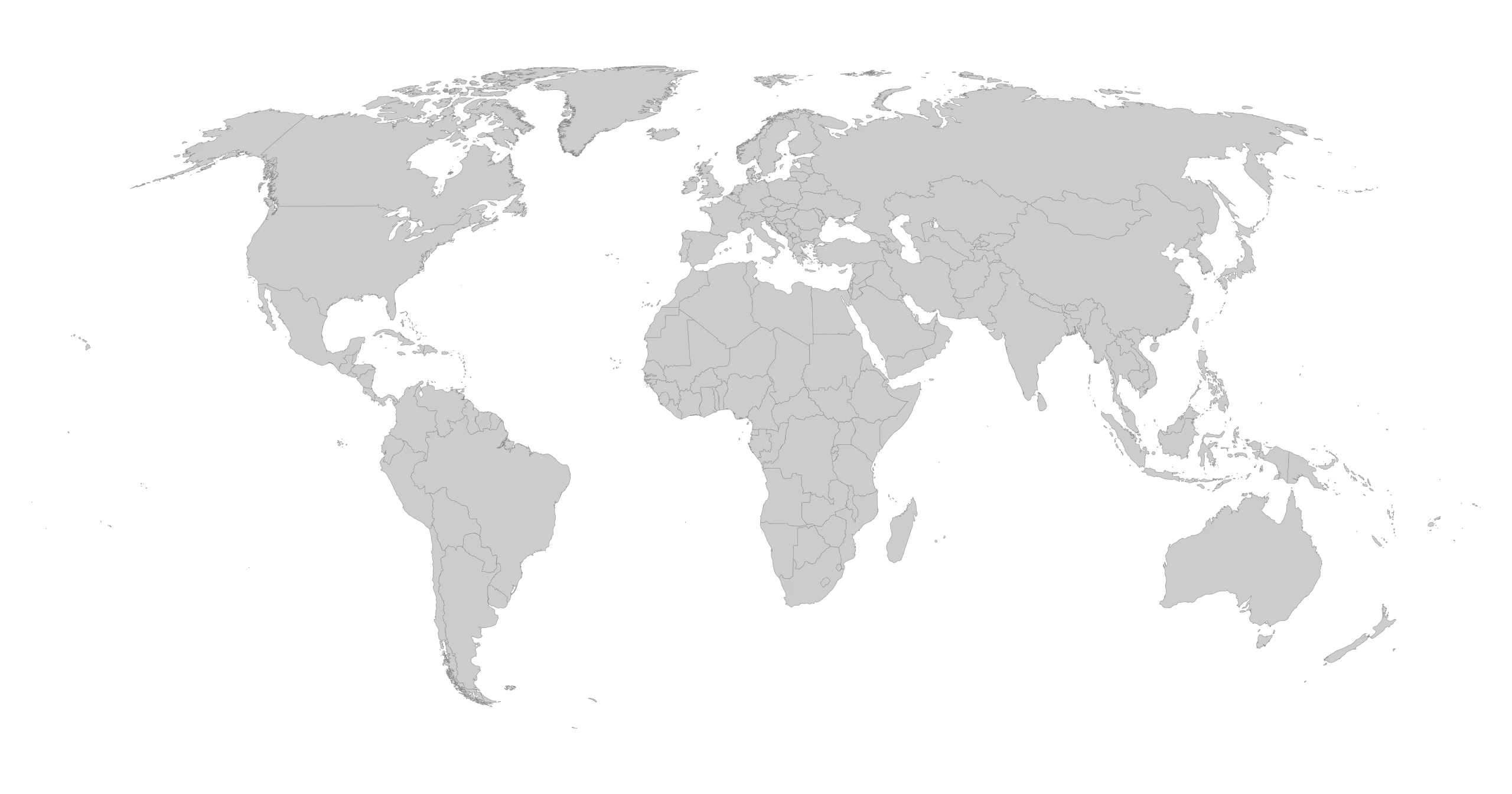
Origin influences the quality of a morganite. Several regions worldwide supply high-quality stones.

Recognising Morganite

Morganite has characteristic properties that make it possible to identify.

Distinguishing it from similar stones

Pink morganite can be mistaken for pink kunzite, pink tourmaline or pink sapphire. Morganite’s pleochroism is less pronounced than that of kunzite. Pink tourmaline often shows a brownish undertone. Pink sapphire is considerably harder and more expensive.

Membership of the beryl family can be clearly established by gemmological tests. For valuable stones, we recommend a certificate from a recognised institute.

menu-img
menu-img

Morganite as an investment

Morganite is an attractive gemstone with growing popularity. As a beryl, it shares its mineralogy with the valuable emerald. Nevertheless, we do not recommend it as a primary investment.

Arguments in favour of morganite include its membership of the prestigious beryl family and rising demand driven by trend colours such as pink and peach. High-quality stones from Madagascar or Brazil are becoming increasingly rare. Entry prices are moderate and make it possible to acquire large, high-quality stones.

Arguments against morganite as a main investment are its good availability in large sizes, which keeps the price per carat low. Widespread heat treatment makes it difficult to value untreated stones. There is no established secondary market as there is for the Big Four.

Our recommendation is therefore to invest first in the established investment gemstones ruby, sapphire, emerald and tanzanite. Morganite can then be an interesting addition for collectors and lovers of the beryl family.

We would be happy to advise you on your personal investment strategy – free of charge and without obligation.

menu-img

Price development of morganite

How morganite prices have developed is shown by an analysis carried out by a sworn expert appointed by the IHK (German Chamber of Industry and Commerce): he determined the average prices in 2013 and 2024 for morganites of 5, 10 and 20 ct – in each case in medium quality and in investment quality. For comparison, we also list our current prices (as of 2026).

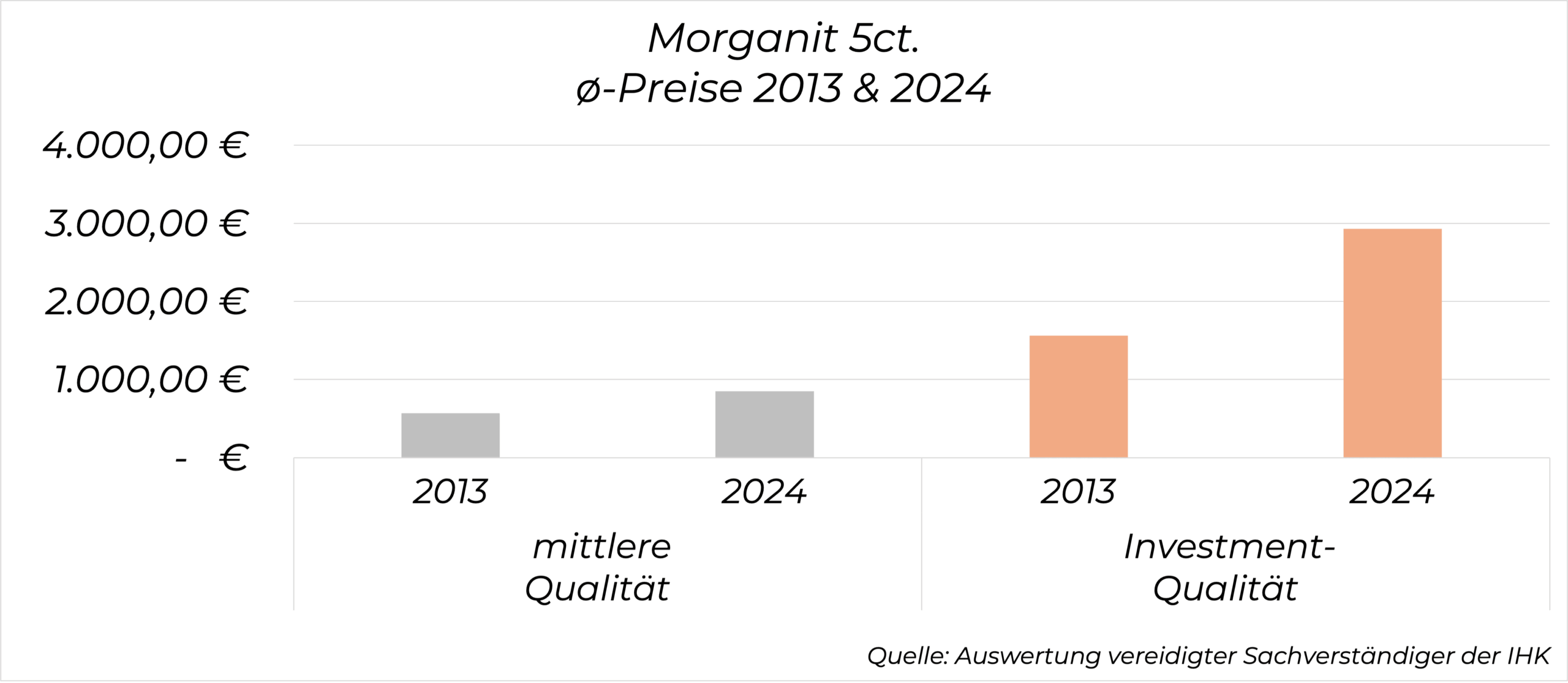
Price development of morganite, 5 carats

In 2024, a 5.0 ct morganite in investment quality cost around €2,950 on average

In 2013, five-carat stones in investment quality averaged around €1,550. By 2024, their value had risen to around €2,950 – almost double. In medium quality, prices rose from around €570 to around €850.

For comparison, our current range (as of 2026): morganites between 5 and 13 ct cost around €610 to €740 per carat with us.

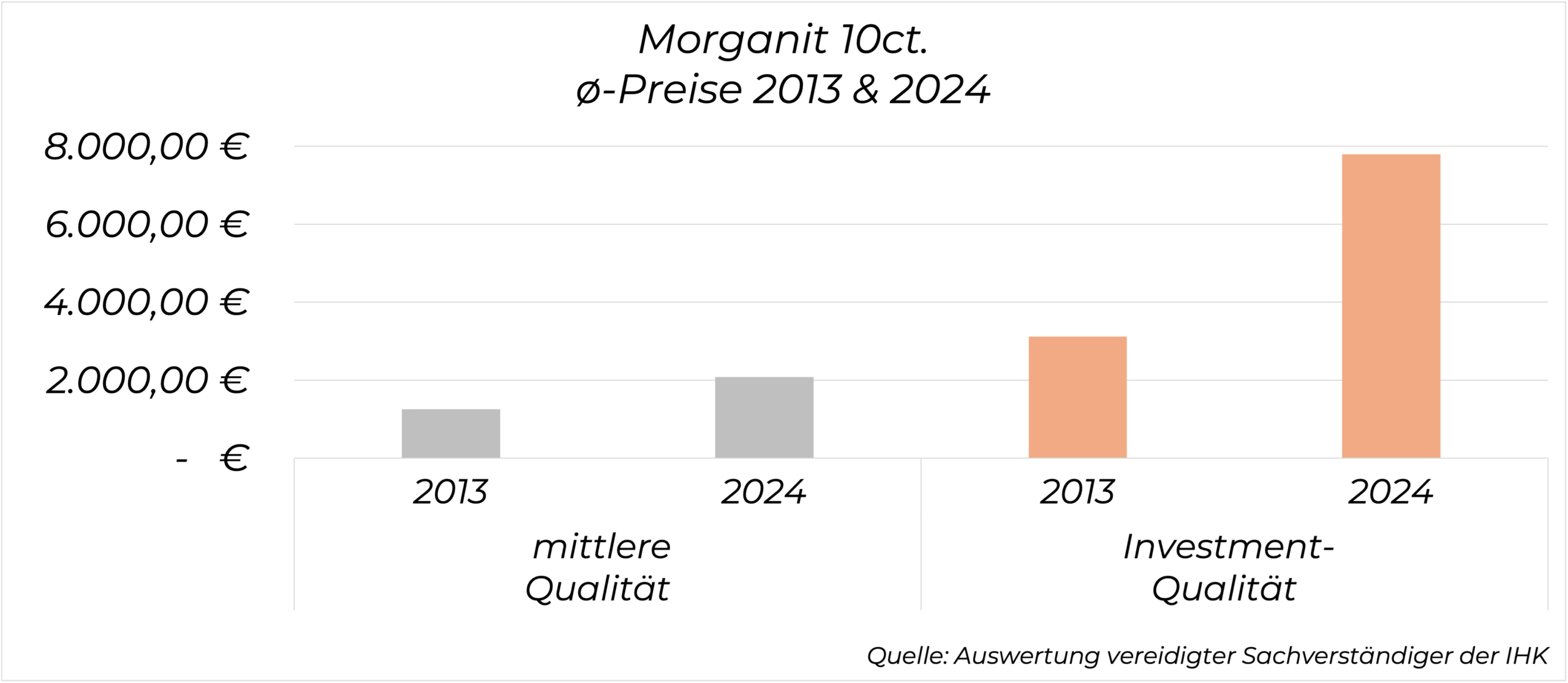
Price development of morganite, 15 carats

In 2024, a 10.0 ct morganite in investment quality cost around €7,750 on average

For ten-carat stones, the average price in investment quality more than doubled: from around €3,100 (2013) to around €7,750 (2024). Stones in medium quality rose from around €1,250 to around €2,100.

Price development of morganite, 20 carats

In 2024, a 20.0 ct morganite in investment quality cost around €19,000 on average

The development is most pronounced for large stones: morganites of 20 ct in investment quality cost around €5,400 on average in 2013 and around €19,000 in 2024 – that is, around €950 per carat. In medium quality, the price doubled from around €2,450 to around €4,900.

Please note:

With morganite, the gap between qualities widens with size. At 20 ct, a stone in investment quality costs almost four times as much as a stone in medium quality.

Types of Gemstones